
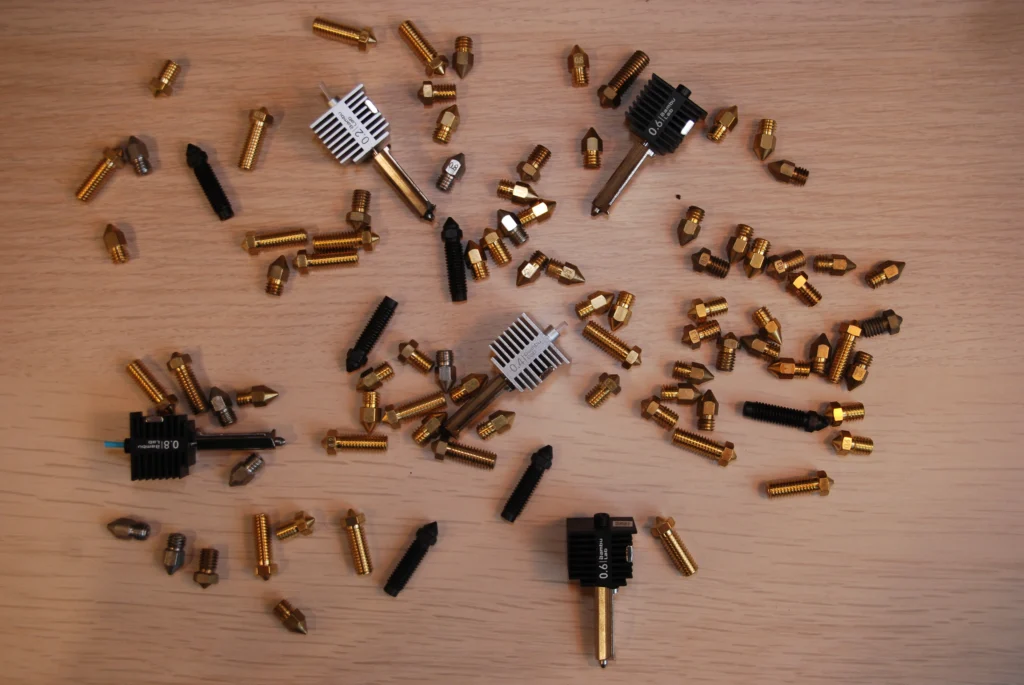
What is it?
At its most basic, FDM (Fused Deposition Modelling) 3D printers work by extruding molten polymer through a small nozzle. This nozzle follows a toolpath to draw out a 2D layer in the X and Y axes, stacking multiple layers on top of one another to build a 3D shape. So where does nozzle size come into this?
Nozzle diameter, to use the correct term, determines the volume of plastic that can be extruded at any one time, this is known as the Volumetric Flow Rate. It is, however, not the only factor that contributes to the maximum volumetric flow rate. Others include:
- Extruder motor torque
- Extruder motor speed
- Peak hot end temperature
- Slicer settings
- Material
- Melt zone length
Nozzle Sizes
The most common nozzle diameter is 0.4mm, which offers a balanced mix of strength, quality, and speed. So why would you choose a different size?
Swapping to a 0.2mm nozzle will significantly increase print times, but it will have an equally significant effect on print quality. A 0.2mm nozzle allows you to print much thinner layers, increasing resolution in the Z axis. With half the diameter in the X and Y axes, it can plot more, finer lines to produce the same shape, effectively doubling the detail. Outside of the increased print time, however, the biggest drawback of a smaller nozzle is reduced part strength.
In comparison, a larger nozzle diameter, such as 0.6mm, produces much thicker lines. This reduces print time considerably, though at the cost of resolution. Speed is not the only reason to go larger, though. A bigger nozzle can also significantly increase the strength of a part, for the same reasons outlined below: thicker lines cool more slowly, which leads to a stronger molecular bond between layers.
Strength and Clogging
Nozzle diameter directly impacts strength through layer bonding, that is, the strength of the molecular bond that forms between each layer. With a smaller nozzle, the extruded filament is thinner and cools more quickly, meaning the next layer may not bond as well. With a larger nozzle, the material retains more heat and bonds more effectively. There is also a structural consideration: because a typical nozzle is circular, the extruded material is also roughly circular in cross-section. When round profiles are stacked side by side on a flat plane, small gaps inevitably form between them. This is equally true of the lines and layers in FDM printing. A smaller nozzle requires more lines and more layers to fill the same volume, resulting in more of these gaps, and a weaker part overall.
Finally, clogging. As the name suggests, the nozzle can become blocked during printing. This can be caused by a number of issues, but contaminants within the filament are among the most common culprits. A smaller nozzle is more susceptible to clogs, as it acts as a bottleneck for anything that doesn’t melt cleanly. For this reason, it is generally recommended to use a nozzle of at least 0.4mm, if not larger, when printing with fibre-filled materials. The most common fibres used in 3D printing are carbon fibre and glass, both of which exist as strands or particles that do not melt with the surrounding polymer, increasing the risk of a blockage.

WRITTEN BY OLIVER ROTHNER
Award-winning product designer and engineer.
Currently working as Project Manager at Pro2Pro whilst obtaining further qualifications.