
Introduction
I have always wanted to get into the CNC world but unfortunately the barrier to entry had always been too high. Recently, someone asked my ‘Why did you pick 3D printing and not CNC?’ and my answer was the same, the barrier to entry is too high mostly due to the high price and knowledge required. But this got me thinking, is this still the case?
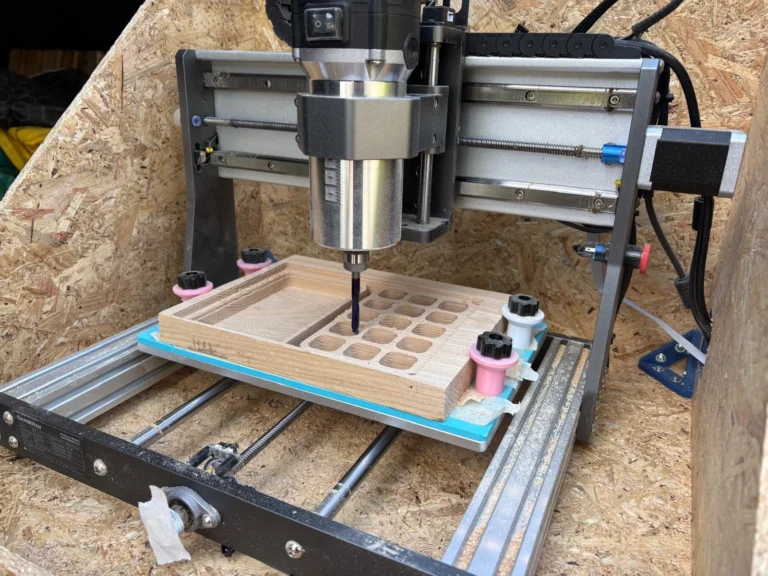
The answer is no. After lots of research I have discovered that the price of an entry level CNC has reduced dramatically and there is now an online community of people able to help and give support. For this reason I decided to purchase my first CNC: the Genmitsu 3020 Pro Ultra.
The Genmitsu 3020 Pro Ultra is a 3 axis CNC machine that features a 710 watt spindle with a ER11 collet, a bed size of 300mm x 200mm x 80mm and an all metal construction for rigidity. It is capable of machine almost any material within reason such as hardwoods, plastics, composites, and metals including aluminium and steel.
My experience
Before ordering the machine, I had to ensure I would be capable of using the software to program it. My chosen software for this is Fusion as it is free for personal use and I am also familiar with the design and render aspect of it. After much research, test programs and running simulations I felt ready to take the next steps.
Once the CNC had arrived and I’d assembled it, I started by doing some test programs into a block of Ash. The reason I chose this hardwood is due to its cost in comparison to aluminium for example, and much of the online community I had discovered used only woods so I felt if anything went wrong I would be able to get support easier. From here, I started making my programs more complex using more tools in the manufacture section of Fusion. My first program was a simple engrave, my most recent program involved 2 tool changes, adaptive clearing, adaptive pocket clearing, engraving, chamfering, boring and surfacing.
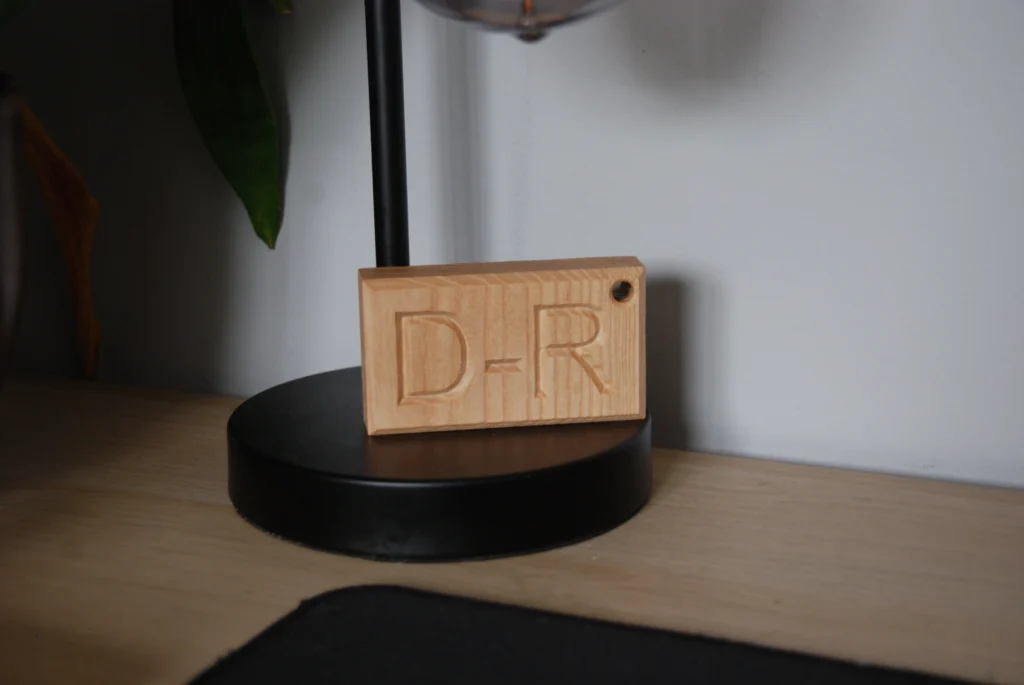
What I quickly learnt is that this is very different to 3D printing. This involves multiple passes, tools and a big focus on correctly finding the origin of the stock. Another learning curve was how to optimise designs to be CNC machined and how material affects this. For example, in one of my initial programs I had designed a wall thickness of 2mm into my part as my experience in 3D printing told me this would work. However, put into practice using this new machine and new materials I quickly learnt that this could result in a fragile part that easily chips, as I found out the hard way.
Another stark difference compared to 3D printing is the tools. In 3D printing you may have different nozzle diameters but these are static throughout the whole duration of a print and the same nozzle is used for every feature on the part. Not only do you get different diameter tools which is similar to 3D printing, you get different tools which are specialised in different things. For example, as my machine is only 3 axis, I couldn’t use my standard flat nosed endmill to chamfer the edges of a part, I need a 90 degree v bit.
But what benefits are there? Well straight off the bat, parts machined instead of 3D printed are isotropic in strength as they have no layer lines that act as a point of weakness only in one axis. This is because parts start a solid block and material is removed to leave a final part, whereas a 3D printer lays downs 2D lines of plastic along a specific toolpath that slowly build up to create a 3D part. Materials are also a big benefit. My singular CNC machine is able to do plastics, hardwoods, metals, composites and more, whereas my 3D printers are limited to polymers and if I wanted to use more specialised materials such as aluminium I would need to purchase a very expensive second machine.
My initial impressions are very good. The machine is capable of using almost any material within reason and produces high quality parts to low tolerances. I am aware that there is a lot I still need to learn and I am excited to dive deeper into this sector.

WRITTEN BY OLIVER ROTHNER
Award-winning product designer and engineer.
About to join Iscar as a level 6 manufacture engineering apprentice.