
Introduction
3D printing was first invented in the 1980s by Charles Hull in the form of stereolithography (SLA). However, in recent years it has seen a significant increase in use as the technology has begun to catch up with its potential. The biggest improvements have been in consistency, capability, price, and accessibility. Advancements over the last decade have lowered the barrier to entry and significantly increased printer performance.
What is FDM?
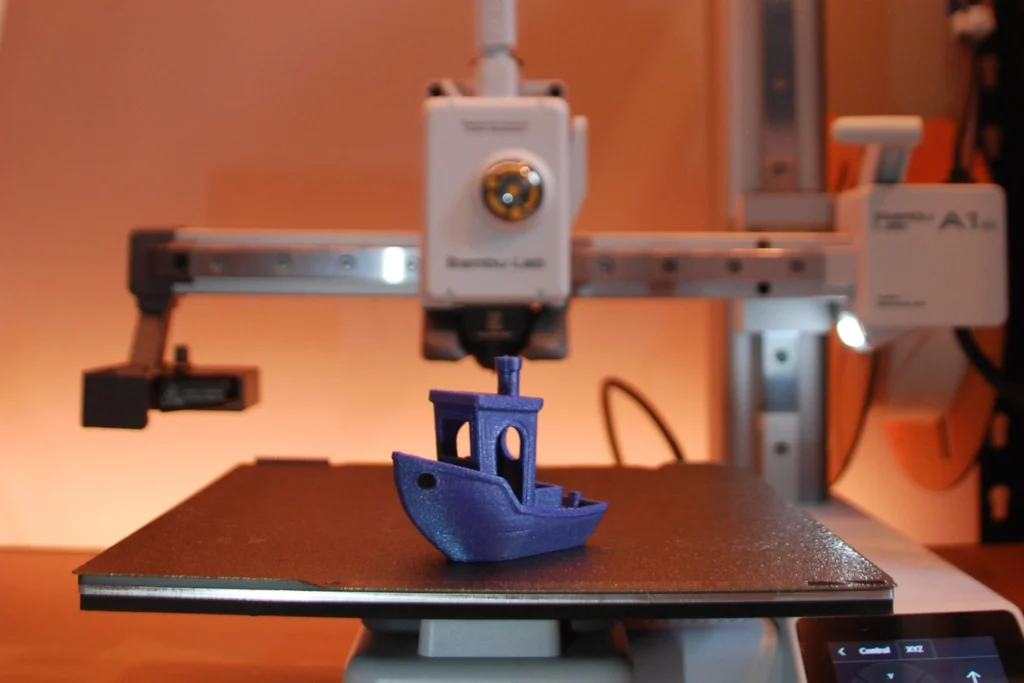
FDM is now the most popular and widely used 3D printing method. This is largely due to the fact that it is the most accessible and cost-effective. FDM (Fused Deposition Modelling) works by using a small nozzle, typically heated between 180°C and 260°C, to melt plastic filament fed in by an extruder motor. Stepper motors control the movement of the nozzle along the X, Y, and Z axes. The nozzle then extrudes the molten polymer in precise paths, similar to drawing a 2D shape, stacking multiple layers to form a 3D object. Compared to SLA and SLS (Selective Laser Sintering), FDM requires minimal post-processing, while the equipment and materials are far cheaper and more widely available.
Impacts on prototyping
With today’s technology, almost anyone can buy an entry-level 3D printer and have it running within an hour. But how has this revolutionised prototyping? Before 3D printing was widely available or affordable, prototypes were typically produced using milling, CNC machining, cardboard, or foam models. While each of these methods has its benefits, they often fall short in terms of cost, speed, or dimensional accuracy. 3D printing addresses all of these limitations.
A fully functional prototype can often be produced in less than an hour, depending on size and complexity. Combined with the affordability of both materials and equipment, this makes rapid prototyping and iterative design not just possible, but accessible. Typical FDM printers can achieve tolerances of below 0.2 mm, often better. Additionally, many engineering-grade materials such as nylons and glass or fibre-filled filaments can be printed on more advanced machines, allowing prototypes to closely replicate the properties of the final product.
This technology is not only useful for prototyping, but also for manufacturing one-off parts, particularly where dimensional accuracy and specific material properties are required. Alternative manufacturing methods for low-volume parts are often time-consuming, expensive, and may not achieve the same level of quality or design freedom as 3D printing.
Beyond prototyping: Unique capabilities
There are also many parts that can only be manufactured using 3D printing. Generative design, for example, often results in complex geometries such as lattice structures, undercuts, and fully enclosed cavities. Many 3D-printed parts also feature fully enclosed components such as magnets. This can be achieved by pausing the print at a specific layer height, inserting the component, and then resuming the print to fully seal it inside the part, something not possible using traditional manufacturing methods. Furthermore, 3D printing enables ‘print-in-place’ designs, where moving features such as joints or bearings are manufactured in a single process. Conventional manufacturing techniques would be unable to achieve this without assembly.

WRITTEN BY OLIVER ROTHNER
Award-winning product designer and engineer.
Currently working as Project Manager at Pro2Pro whilst obtaining further qualifications.